Indoteak is a premium flooring company specializing in high-quality wood flooring and related products. While the company had an established brand, strong products, and an existing customer base, its digital infrastructure was limiting its ability to generate incremental revenue online. The biggest opportunity wasn't simply to "get more traffic." It was to create a digital ecosystem that could turn existing demand into measurable online revenue while simultaneously creating new demand through paid search.
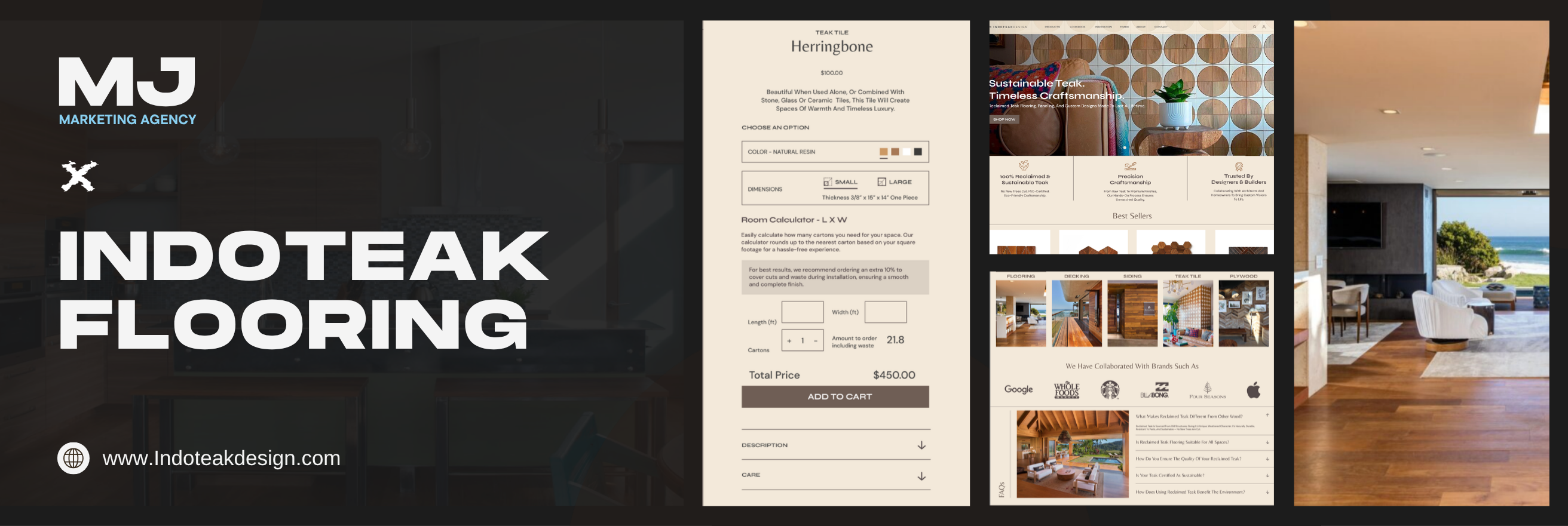
When Indoteak came to us, the business had a strong foundation offline, but its website wasn't equipped to take full advantage of the opportunity happening online.
The existing WordPress website functioned primarily as an informational resource. Customers could learn about the company and its flooring products, but there was no true e-commerce infrastructure allowing them to purchase products directly online.
That created a significant ceiling on digital revenue.
People increasingly expect to be able to research, compare, and purchase products online. For a flooring company, this is especially important because the customer journey often begins with research. A homeowner may search for a specific type of hardwood flooring, a contractor may be looking for a particular product or specification, or an interior designer may be researching options for a project.
If the website can't accommodate that intent, the business risks losing the customer before the sales process even begins.
Our objective with Indoteak wasn't to replace the company's existing revenue channels.
It was to add another one.
The strategy was built around creating a modern digital sales infrastructure that could support both organic traffic and paid acquisition.
The first step was rebuilding the website and migrating Indoteak from WordPress to Shopify.
Shopify gave the business a significantly stronger foundation for managing products, orders, customers, inventory, and future marketing initiatives. More importantly, it transformed the website from a primarily informational asset into a platform capable of directly generating revenue.
But the website migration wasn't treated as a simple redesign.
We approached it as a growth project.
One of the biggest risks when rebuilding an established website is accidentally damaging the organic visibility the company has accumulated over time. Indoteak had existing blog content and SEO value that needed to be preserved.
Rather than starting from zero, we carefully brought over the company's historical blog content and structured the new website to retain as much existing SEO equity as possible.
This allowed us to modernize the customer experience without unnecessarily sacrificing the organic foundation that had already been built.
The result was a website designed around one central idea:
Make it easier for people to discover Indoteak, understand the products, and ultimately become customers.
The first phase was migrating Indoteak from WordPress to Shopify.
This wasn't simply a platform change. The website needed to support the next stage of the company's growth.
We focused on creating a structure that could support:
The goal was to make the website work harder for the business.
Instead of relying on customers to call, email, or manually request information, the new infrastructure gave them a clearer path toward purchasing and converting.
Website migrations can create hidden problems.
A company can launch a beautiful new website and still lose valuable organic traffic if historical pages, blog content, URLs, metadata, and internal linking aren't properly considered.
For Indoteak, we made preserving the existing content ecosystem part of the migration strategy.
Historical blogs were brought over to Shopify so the business wouldn't unnecessarily abandon years of accumulated content.
This was important because content doesn't only generate traffic today. It can continue introducing new potential customers to the company months and years after it is published.
The goal was therefore not to choose between a new website and existing SEO.
We built the new website while protecting the old site's valuable digital assets.
Flooring isn't necessarily an impulse purchase.
Customers often have questions before they're ready to buy:
What type of flooring should I use?
What style works with my home?
How much flooring do I need?
What does the product look like in a real space?
How does this flooring compare with another option?
Is it appropriate for a specific room or project?
That means the digital strategy needs to accommodate customers at different stages of intent.
We structured the website and marketing strategy around that journey.
High-intent visitors can be directed toward products and purchasing.
Research-oriented visitors can consume educational content.
Visitors who aren't ready to purchase can be introduced to the brand and eventually remarketed to.
This creates a much larger opportunity than simply running advertisements directly to a product page.
Once the new website was in place, we moved directly into a long-term Google Ads strategy.
This was a natural next step because Google captures something incredibly valuable:
existing intent.
Someone searching for flooring isn't necessarily being convinced that they need flooring.
They already have a problem.
They're actively looking for a solution.
The strategy was therefore designed to capture that existing demand and guide it toward Indoteak.
Rather than treating Google Ads as one giant campaign, we would approach the account around different levels of search intent.
These searches are closest to a purchase decision.
Examples could include searches around specific flooring types, wood species, flooring styles, colors, finishes, and product categories.
These campaigns can be built around highly relevant landing pages so that the person searching for a particular product immediately sees the product or category most relevant to their query.
The next layer captures broader commercial searches.
For example, someone may know they want hardwood flooring but haven't decided exactly which product they want.
These searches can be directed toward category pages designed to help the customer compare options and move further down the funnel.
Flooring is also heavily influenced by location.
Depending on Indoteak's service and shipping footprint, campaigns can be segmented around the markets where the business can actually fulfill demand profitably.
This allows advertising dollars to be concentrated where the company has the strongest opportunity rather than paying for irrelevant clicks.
Brand campaigns can protect demand from customers already familiar with Indoteak while providing an inexpensive way to capture highly qualified traffic.
These campaigns also help separate existing brand demand from new customer acquisition when analyzing account performance.
Not every flooring customer is going to purchase on their first visit.
A customer might visit the website, look at several products, compare options, leave, and return several days later.
Remarketing gives the business the ability to stay in front of those customers throughout that decision-making process.
For a higher-consideration product like flooring, that additional exposure can be extremely valuable.
The biggest result wasn't simply launching a new website.
It was creating an entirely new digital revenue channel for the business.
Before the project, Indoteak's website wasn't capable of functioning as a true e-commerce engine.
After the Shopify migration, the company had a platform capable of generating direct online orders while also supporting lead generation, SEO, Google Ads, remarketing, and future digital expansion.
That distinction is important.
The goal wasn't to take customers who would have otherwise purchased through another channel and move them online.
The objective was to capture incremental demand that the company previously couldn't effectively monetize.
The new website became the foundation.
Google Ads became the acquisition engine.
SEO became the long-term traffic strategy.
And the combination created a scalable digital ecosystem that could continue improving over time.
Instead of looking at the website as a brochure for the business, Indoteak could now treat it as a measurable revenue-producing asset.
From there, the strategy can continue expanding through additional product-specific campaigns, Shopping and Performance Max opportunities, improved landing pages, conversion-rate optimization, remarketing audiences, educational content, and expanded keyword coverage.
The most important takeaway is that digital growth doesn't always begin with advertising.
Sometimes, the biggest opportunity is building the infrastructure that allows advertising to actually work.
For Indoteak, that meant turning the website from an informational destination into a digital storefront — and then putting a long-term customer acquisition strategy behind it.