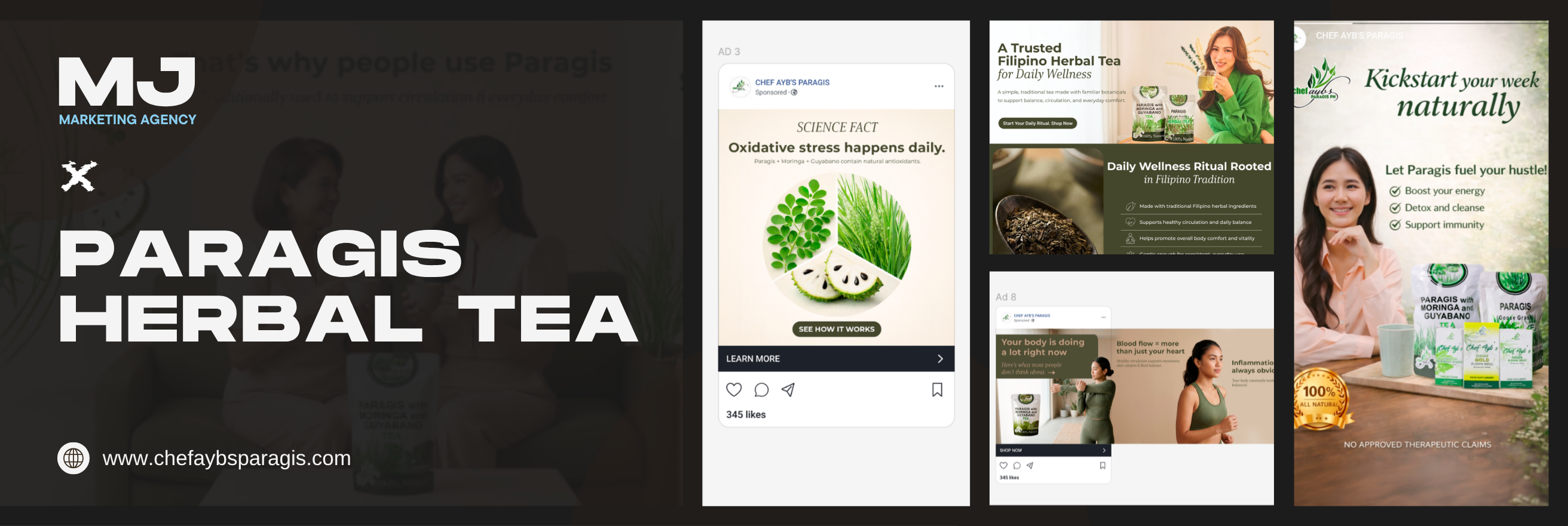
Paragis Herbal Tea came to us with a product built on generations of heritage. The formula had already been successful overseas, but the brand had struggled to translate that success into the U.S. market. Our goal was to modernize the digital experience, introduce the product to American consumers, and build a profitable customer acquisition system.
Paragis wasn't a brand that needed a new product.
It needed a new way to introduce an existing product to a new audience.
The formula had a long history, but U.S. consumers weren't familiar with it. That meant our advertising strategy couldn't simply say, "Buy Paragis."
We needed to educate first.
Our strategy combined a conversion-focused Shopify website with Meta advertising and ongoing CRO. The goal was to make every part of the customer journey work together — from the first ad impression to the eventual purchase.
We optimized the Shopify experience to make the product easier to understand, trust, and purchase.
Because this was a product many consumers were unfamiliar with, education was critical. The website needed to communicate the brand's heritage while making the product approachable to a modern U.S. consumer.
We continuously tested and improved messaging, product presentation, calls to action, trust elements, and the overall shopping experience.
Rather than relying exclusively on traditional product advertising, we developed problem-and-solution-based creative.
The ads started with problems consumers were already experiencing and then introduced Paragis as a natural solution they could explore.
This gave us a much stronger way to educate consumers who had never heard of the brand.
Instead of:
"Here's our herbal tea. Buy it."
The strategy became:
"Here's a problem you may be dealing with. Here's a natural product that may help."
That approach allowed us to build awareness, educate the audience, and create demand around the product rather than relying solely on existing brand recognition.
As Meta generated traffic, we continuously used the data to improve the Shopify website.
We weren't just looking for cheaper clicks. We were looking for more valuable customers.
Creative performance, customer behavior, conversion rates, and purchasing patterns all informed ongoing optimization.
This created a feedback loop between advertising and the website that allowed the entire funnel to improve over time.
The result was a 2X ROAS on Meta Ads.
For a CPG brand, however, the front-end ROAS only tells part of the story.
Paragis is a consumable product, meaning customers don't necessarily make a single purchase and disappear. Once someone becomes a customer and enjoys the product, they have the potential to purchase repeatedly through subscriptions and replenishment.
That makes a 2X front-end ROAS particularly valuable.
We're not only looking at the revenue generated from the first order. We're looking at the potential lifetime value of the customer acquired through that first purchase.
The strategy therefore wasn't built around maximizing a single transaction.
It was built around acquiring customers who could become long-term customers.
By combining educational problem-and-solution advertising, a conversion-focused Shopify experience, and continuous CRO, we helped transform a traditional product with a long overseas history into a scalable U.S. digital acquisition channel.
Heritage created the story.
Education created the demand.
Meta created the acquisition engine.
And the subscription model created the long-term value.