

1️⃣ Strategy Overview: Persona-Based Campaign Structuring
Definition:
Each campaign is designed around a specific buyer persona (e.g., “Wellness Mom,” “Gym Enthusiast,” “Homebody Shopper”), not just funnel stage.
Why it works:
- Aligns audience, offer, and creative at the campaign level
- Simplifies creative testing and learnings
- Improves message–market fit and creative resonance
- Enables persona-based budget control and scaling decisions
Example Structure:
Campaign 1: The Wellness Mom 🧘♀️
→ Ad Set 1: Broad targeting, 25–45, interest stack: Organic supplements
→ Ad Set 2: LLA – Purchasers (180 days)→ Ads: Content suite relevant to "The Wellness Mom"
Campaign 2: The Gym Guy 💪
→ Ad Set 1: Broad targeting, 18–35, interests: Fitness, Creatine
→ Ad Set 2: Remarketing – Video viewers 95%
→ Ads: Content suite relevant to "The Gym Guy"
2️⃣ Account Consolidation Strategy [Andromeda Update]
Why we consolidate:
Andromeda is Meta's new AI-driven retrieval system, which means how Meta decides which ad to show a specific person when it has thousands of advertisers to pick from. We often see best performance when the account is simplified to one or two campaigns total — particularly for brands spending <$50k/mo or with a consistent offer.
Benefits:
- Facebook’s AI optimizes across creatives and personas
- Reduces audience overlap and “learning fatigue”
- Stabilizes performance at scale
- Adromeda has thousands of data points to determine which creative to serve each user
- Meta's tech and AI infrastucture can our target humans
- You'll lose some control, but you'll gain velocity and focus on connecting with your customer while driving results.
How we consolidate:
- Consolidate campaigns with the same objective, and focus on feeding the campaign (algorithm) with creative.
- Creative has become the targeting. We've said this before, but this time we really mean it.
- Usually this means: One campaign, One Ad set, Many Creatives, Broad Targeting, Smart Exclusions.
- Use exclusions to focus on net new customers and revenue.
- Ad sets can hold up to 50 ads for a reason. Launch 10-15 unique creatives biweekly - different angles and wide swings, not small tweaks.
Example Structure and workflow.
- Simple campaign structure. One CBO campaign per objective (lead, conversion, call schedule)
- Launch Biweekly Creative. (10-15 unique creatives - different angles and wide swings)
- Add exclusions. Focus on driving new revenue.
3️⃣ Ad Performance Decision Framework: When to Turn Off Ads
Option A: Data-Driven Pausing (Manual Optimization)
We turn off non-performers when:
The ad has >1,000 impressions and
- CPA > 2.5x target
- CTR < 0.8% (cold) or < 1.2% (warm)
- No conversions after 2-3x target CPA spend
✅ Use when:
- Budget is limited
- We’re rapidly testing new creatives
- We want to prioritize best performers for efficient scaling
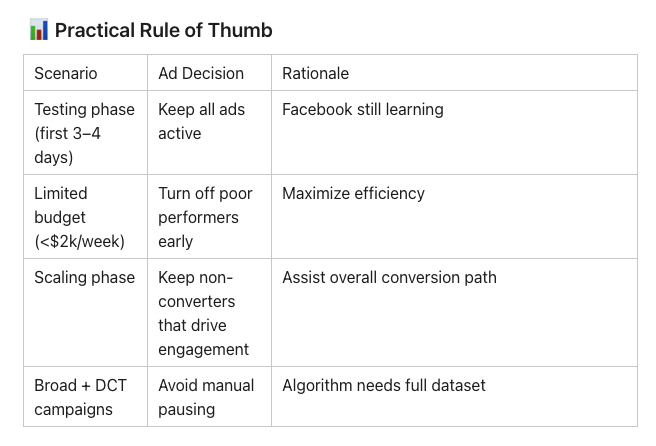
Option B: Algorithmic Optimization (Let Facebook Decide)
We keep all ads running when:
- We’re optimizing within Advantage+ or broad dynamic campaigns
- Ad-level spend distribution is uneven but performance stable at the campaign level
- Ads are playing a “support role” (e.g., driving top-funnel engagement or assisting conversions)
💡 Note: Some ads with low direct ROAS still help overall campaign performance by:
- Increasing relevance score
- Providing fresh creative rotation signals
- Fueling remarketing audiences
📊 Practical Rule of Thumb
4️⃣ Scaling Frameworks
When scaling horizontally:
- Duplicate high-performing ads into new persona campaigns
- Test creative hooks or landing pages for the same offer
When scaling vertically:
- Gradually increase budget by 20–30% per day if ROAS is stable
- Use ASC (Advantage+ Shopping Campaign) for broad-based scaling
- Layer UGC + offer-based creative mixes for freshness
5️⃣ Learnings from 2025 Data
- Persona-based segmentation outperforms funnel-stage segmentation for top-performing D2C brands.
- Over-consolidation (1 campaign, all audiences) works best for mid-to-high spenders when paired with high-volume creative testing.
- Non-converting ads often correlate with higher remarketing conversion rates (assist role validated).
If you want to learn more about how we use funnels to supercharge ecommerce growth, or are interested in our team building funnels for your store schedule a call directly using this link. Our agency offers a risk free 15 day trail to ensure perfect alignment.
